04/27/2026 // LLM Research
Best LLM for coding in 2026
A practical ranking of coding LLM tools in 2026 by usage allowance, state-of-the-art intelligence, and wide problem complexity handling.
The ranked view is easier to understand if you separate the three things people usually collapse into one question.
If you ask me what the best LLM for coding is in 2026, I do not think there is one clean answer anymore.
There are at least three different rankings that matter.
One ranking is usage allowance: who lets you do the most real work for the money. Another is state-of-the-art intelligence: who is at the top when the problem is genuinely difficult. The third is wide problem complexity: who can handle a broad, messy, high-touch task across many files, decisions, constraints, and follow-up corrections.
Those are not the same thing.
A model can be brilliant and still not be your daily driver if the limits are too tight. A tool can be generous and still not be the one you want on a dangerous refactor. A model can spike on hard benchmark-style problems and still be annoying on a wide product task that needs taste, patience, and continuity.
So this is not a single scoreboard. This is how I currently rank the coding LLM stack by the jobs I actually need these tools to do.
Ranking by usage allowance
This is the first ranking I care about for daily work.
Usage allowance means: how much useful work can I get done before I hit the wall, get rate-limited, burn too much API spend, or have to start thinking about the meter instead of the project?
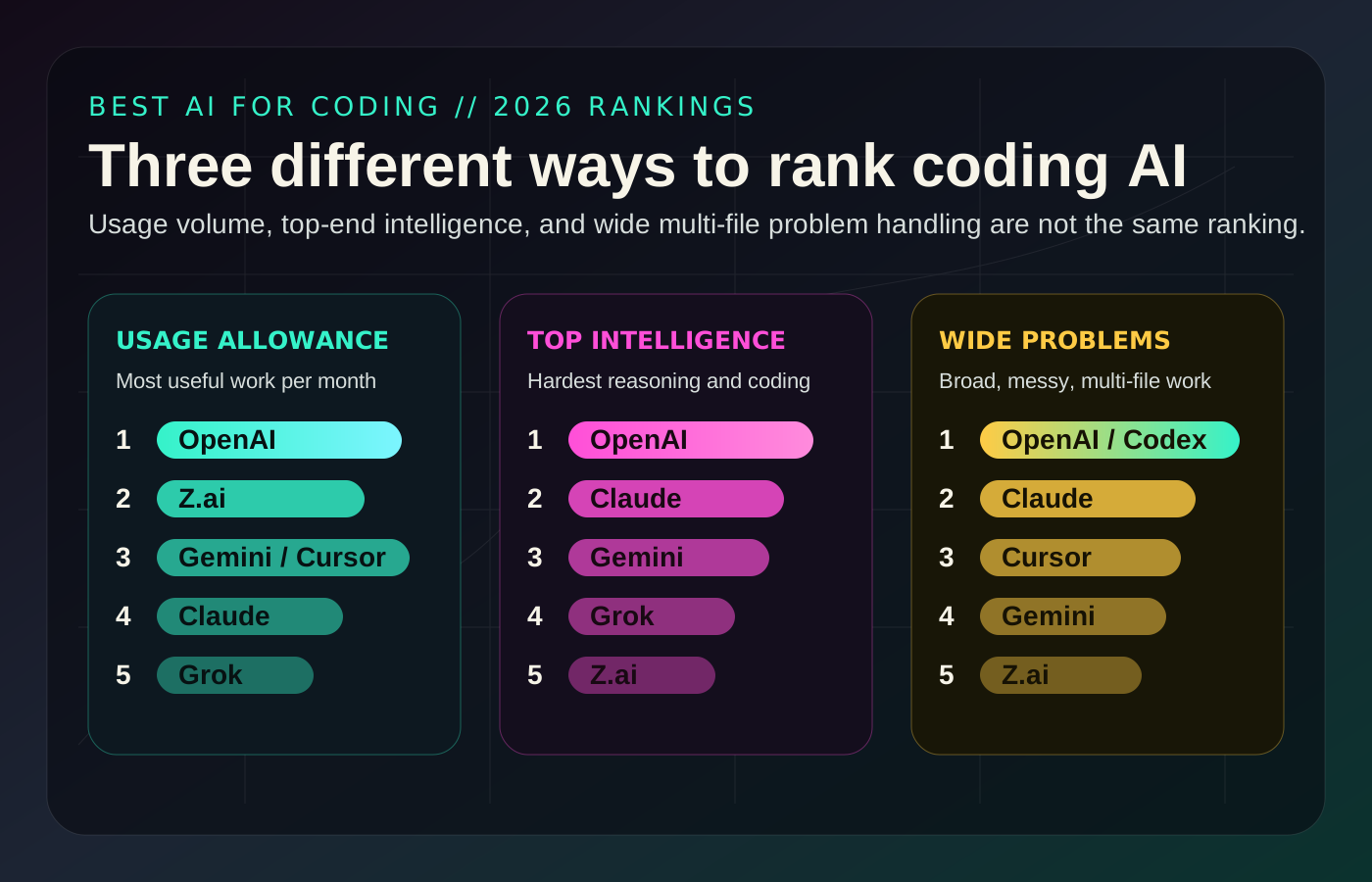
My current practical ranking by usage generosity is:
- OpenAI
- Z.ai
- Gemini / Cursor
- Claude
- Grok
OpenAI is currently my number one for usage allowance because it gives me the best mix of capability and practical working volume. When I am coding for hours, that matters more than small differences in taste or personality.
Z.ai is high because the value profile is strong. It is useful when I want more runs, more attempts, and more experimentation without feeling like every prompt has to be precious.
Gemini and Cursor sit in a similar zone for me. The exact answer depends on whether I am thinking about model access, IDE workflow, or how much work I can push through a subscription-style product.
Claude is extremely useful, but I do not rank it as highly on usage allowance. It is one of the tools I want available, but not always the tool I want carrying the whole day.
Grok is something I keep testing, but it is not my primary answer for coding usage right now.
For personal and hobby work, I strongly prefer subscriptions over direct API usage. Direct API can get expensive fast if you are using these tools the way I use them: long coding sessions, multiple attempts, refactors, reviews, debugging, and agents running through real project work.
The question is not just price. It is compute per dollar.
If you are coding seriously with LLMs, you need enough usage to make mistakes, recover, ask for alternatives, run review passes, and keep moving. A model that is technically stronger but too constrained can become less useful than a slightly weaker tool you can actually use all day.
Practical takeaway
If you are choosing your first paid LLM coding setup, rank by usable work per month before you rank by hype. The best daily-driver tool is the one you can keep using when the project gets annoying.
Ranking by state-of-the-art intelligence
This is the ranking people usually want first, but I do not think it should be the only ranking.
State-of-the-art intelligence means: when the problem is hard, ambiguous, or technically deep, which model do I trust to reason through it best?
My current practical ranking for top-end intelligence is:
- OpenAI
- Claude
- Gemini
- Grok
- Z.ai
- Cursor’s available models, depending on what it is routing to
OpenAI is at the top for me right now. When I need the strongest reasoning, the best chance at a correct architecture pass, or the most capable coding agent behavior, it is the first place I look.
Claude is still excellent. I especially like it as a second opinion, a reviewer, and a strong alternative when I want a different style of reasoning. Claude has caught issues for me that other tools missed. That does not make the other tools bad. It means Claude is valuable in the stack.
Gemini is strong for analysis and large-context thinking. I often like it when I want another read on behavior, tradeoffs, or a broad explanation of what is happening.
Grok is worth watching and testing, but it is not usually where I start for serious production coding.
Z.ai is useful, but I do not treat it as the top intelligence option. I treat it more as a value and throughput option.
Cursor is a little different because Cursor is not just one model. It is a workflow product. Its ranking depends on which model is underneath and how well the editor experience helps you apply the result.
The mistake is assuming the smartest model should do every task. I do not think that is true. Sometimes the smartest model is too expensive, too limited, too slow, or too heavy for the work. You do not need frontier reasoning to rename a component, wire up a small UI change, or update a config file.
Practical takeaway
Use the strongest model when the decision actually matters: architecture, hard bugs, security-sensitive changes, wide refactors, unclear failures, and places where a bad answer creates expensive cleanup.
Ranking by wide problem complexity
This is the ranking I think more developers should care about.
A spike in difficulty is one thing. A wide problem is different.
A wide problem touches many files. It has product judgment, architecture tradeoffs, existing code conventions, UI behavior, tests, edge cases, and cleanup. It may require the agent to work for a while, notice conflicts, keep context, avoid breaking unrelated things, and make a series of small correct decisions.
This is where a lot of coding LLM tools still separate themselves.
My current ranking for wide, high-touch, horizontal problems is:
- OpenAI / Codex
- Claude
- Cursor
- Gemini
- Z.ai
- Grok
Codex is my strongest default for wide coding work. It is good at repo-level context, multi-file edits, refactors, and moving through a codebase without needing every tiny step spelled out. For large codebases and agentic work, this matters.
Claude is very strong when the work needs careful thought, clean structure, or a second pass. I like it for new projects, design-heavy implementation, review, and places where I want the model to challenge the shape of the solution.
Cursor is valuable because the environment matters. For some developers, having the LLM integrated directly into the editor is more important than squeezing out the absolute strongest model answer. A good workflow can beat a better model used awkwardly.
Gemini can handle wide analysis well, but I do not reach for it as often as the main implementation driver. I like it more as a thinking partner, explainer, and alternate read on a complex situation.
Z.ai can be useful when the work is broad but not extremely risky, especially if cost or volume matters. I would not usually put it in charge of the most sensitive architecture work.
Grok is still not my first choice for wide coding problems.
Wide-problem handling is also where local open-source models fall down for me. They can be interesting. They can be useful for narrow tasks. But locally, for this kind of broad, high-touch coding work, they are largely not competitive with the frontier services yet.
Practical takeaway
If your task crosses a lot of files and decisions, do not only ask “which model is smartest?” Ask which tool can stay coherent across the whole job. Wide work rewards context handling, patience, file discipline, and recovery from mistakes.
How I would actually build the stack
If I were setting up a coding LLM workflow in 2026, I would not pick one tool and pretend it solves everything.
I would build a stack.
For daily coding volume, I would start with OpenAI. It gives me the best mix of intelligence, usage, and practical agent work right now.
For second opinions, review, and clean reasoning, I would keep Claude available.
For analysis and large-context reads, I would keep Gemini available.
For budget-sensitive experimentation, I would keep Z.ai in the rotation.
For editor-first workflows, I would consider Cursor if the developer likes that style of working.
For periodic testing, I would keep an eye on Grok, but I would not make it my backbone today.
The actual workflow matters more than the brand list.
A good LLM coding workflow has a few rules:
- Use generous tools for daily throughput.
- Use the smartest tools for risky decisions.
- Use a second model for review when the change matters.
- Do not let one model own correctness.
- Do not use API billing casually if a subscription gives you more useful work.
- Match the tool to the task instead of treating every prompt the same.
The strongest setup is usually not one model. It is a ranked bench.
What each tool is good for
OpenAI is my current best overall answer. It ranks highly across usage allowance, intelligence, and wide problem handling. If I had to pick one ecosystem to build around right now, this is the one.
Claude is the tool I want for careful reasoning, clean structure, and review. It may not be my highest usage-allowance pick, but I still want it in the stack because it catches different problems.
Gemini is useful for analysis, large context, and fast second reads. I do not always want it driving implementation, but I like having it available.
Cursor is a workflow choice as much as a model choice. If you like living inside an LLM-native editor, Cursor can be the right answer even if the underlying model ranking changes.
Z.ai is useful for value and experimentation. It belongs in the conversation because coding LLM is not only about maximum intelligence. Sometimes the winning tool is the one that lets you keep working.
Grok is worth checking in on, but I would not currently rank it as the top coding choice in any of the three categories I care about most.
Local open-source models are still mostly not worth it for serious coding agent workflows on local hardware. That may change, and I want it to change, especially for privacy and IP reasons. But for wide, high-touch coding work, they are not where I would start.
My final ranking
If I collapse all three dimensions into one practical coding ranking, my answer is:
- OpenAI
- Claude
- Gemini / Cursor
- Z.ai
- Grok
- Local open-source models
That ranking is not permanent. It should not be treated like a sports score. The tools move too fast, usage limits change, and model quality changes constantly.
But if someone asked me what to use today for serious LLM-assisted coding, I would start there.
OpenAI is the best overall default. Claude is the best companion. Gemini is useful for analysis. Cursor is strong if you want the editor workflow. Z.ai is useful when value and usage matter. Grok is worth watching. Local models are not ready for this tier of work unless your needs are narrow or your privacy constraints force the tradeoff.
The real answer is not “which LLM is best?”
The real answer is: best for what?
If you are coding all day, usage limits matter. If you are solving a hard architecture problem, intelligence matters. If you are changing a real product across a messy codebase, wide problem handling matters.
The best LLM for coding in 2026 is the one that fits the job in front of you and can keep showing up after the demo is over.
Article FAQ
Article takeaways
- What is the best LLM for coding in 2026?
- For my workflow, OpenAI is the best overall default because it ranks highly across usage allowance, intelligence, and wide coding problem handling. Claude, Gemini, Cursor, Z.ai, and Grok still have useful lanes.
- Which coding LLM has the most generous usage allowance?
- My current practical ranking by usage generosity is OpenAI first, Z.ai second, Gemini and Cursor around third, Claude fourth, and Grok fifth.
- Which LLM is smartest for coding?
- For top-end coding intelligence, I currently rank OpenAI first, Claude second, Gemini third, then Grok, Z.ai, and Cursor depending on which model Cursor is routing to.
- Which LLM handles wide coding problems best?
- For broad, high-touch coding work across many files and decisions, my current ranking is OpenAI/Codex first, Claude second, Cursor third, Gemini fourth, Z.ai fifth, and Grok sixth.