08/22/2026 // LLM Research
Best LLM for coding in 2026: Late Summer
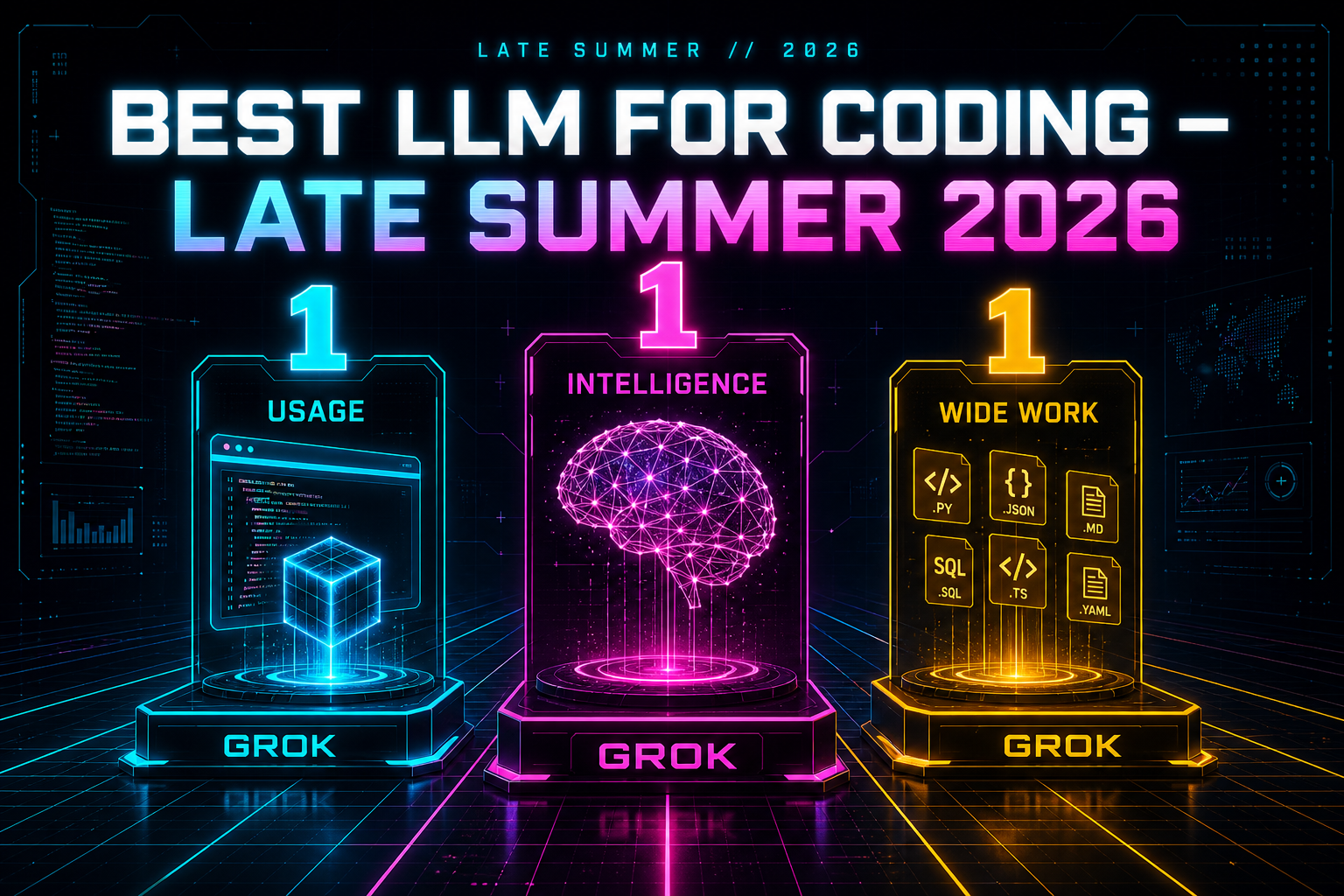
Late summer update to my coding LLM rankings. Same three dimensions as June, plus open source. Grok is now #1 on usage, intelligence, and wide work.
Same three dimensions as the summer edition. The relative positions moved after July’s model wave, and open source leadership changed hands.
If you ask me what the best LLM for coding is in late summer 2026, I still don’t have one simple answer. Two months after the summer edition, the board has flipped harder than I expected.
July and August dumped a dense wave of models. GPT-5.6 Sol, Terra, and Luna. Claude Opus 5. Gemini 3.6 Flash, then 3.7 Flash. Grok 4.5 and then Grok 4.6. Kimi K3. Qwen3.8-Max. GLM-5.3 on the Z.ai side. A lot landed at once, and after living with them on real work, my personal ranking moved.
Same three dimensions as before. Usage allowance, top intelligence, and wide problem handling. Open source still gets its own list.
They still don’t overlap cleanly. What changed is who sits at the top.
Ranking by usage allowance
This still decides what I open when I need a full day of coding without babysitting the meter.
My current ranking:
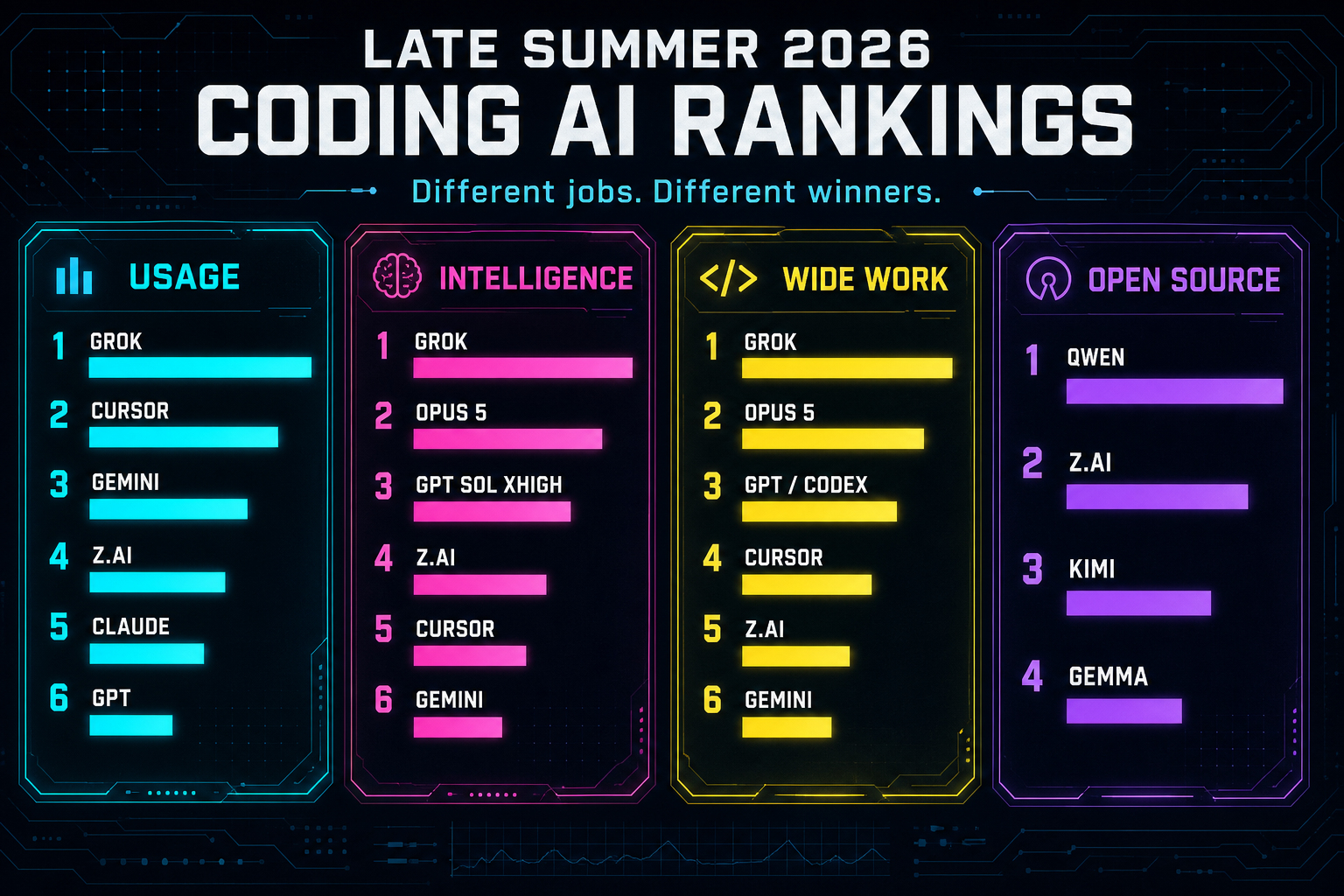
- Grok
- Cursor
- Gemini
- Z.ai
- Claude
- GPT
Grok is now first for me on usable volume, especially on 4.6. Not a tie with Cursor anymore. I can keep going longer before the tool becomes the constraint.
Cursor is still excellent for IDE-heavy days. It just sits behind Grok on raw allowance for how I work.
Gemini is steady and generous enough for consistent stretches.
Z.ai slipped a bit on this list relative to summer, but it is still usable when I want volume without burning the closed-provider budgets.
Claude is strong and I still reach for it, but heavy days run into limits sooner.
GPT remains last for me on allowance. Fine models. Tight room to use them all day.
Ranking by top intelligence
This is the hard-problem list. Not autocomplete. The cases where the model has to hold real constraints and not invent a clean story over a messy codebase.
Current ranking:
- Grok
- Claude Opus 5
- GPT Sol xhigh
- Z.ai
- Cursor
- Gemini
Grok 4.6 took the top slot here too. That surprised me more than the usage win. On the hardest coding passes I’ve thrown at it lately, it has been the one I trust first.
Claude Opus 5 is right behind. Careful, strong, and often the better choice when I want a second opinion that is still near the frontier.
GPT Sol at xhigh is still excellent. It did not fall off a cliff. It just stopped being automatic #1 for me.
Z.ai remains competitive. Cursor and Gemini round it out depending on the task and where I’m working.
The top of this list is tight. Grok, Opus 5, and Sol are not miles apart. On a bad day for one of them, the order can wobble. Across enough real work, Grok is ahead right now.
Ranking by wide problem handling
Messy jobs. Lots of files. Models, APIs, UI, tests, docs, deploy notes. The thread has to survive while you iterate.
Current ranking:
- Grok
- Claude Opus 5
- GPT Sol / Codex
- Cursor
- Z.ai
- Gemini
Grok is #1 here as well. That is the late-summer headline for me: same model on usage, intelligence, and wide work.
Opus 5 is excellent on sprawling jobs that need careful tracking.
GPT Sol and Codex are still strong for wide work. I use Codex in the mix. Skills help when the job is less “answer this” and more “keep moving through a repo.” Sol/Codex still belongs near the top when breadth matters.
Cursor stays great inside the editor. Z.ai and Gemini follow for my use.
Open source
This list moved.
- Qwen
- Z.ai
- Kimi
- Gemma
Qwen took the lead from Z.ai among the open models I’ve been using for coding (Qwen3.8-Max is the one that moved the needle for me). Z.ai is still very good, including the GLM-5.3 line. Kimi and Gemma are close enough that the job decides it.
They are not automatically beating the closed frontier on every hard problem. They are already good enough that open source is not a side note anymore.
How this plays out in practice
I still mix tools.
For daily volume, Grok first, Cursor when I’m deep in the IDE.
For hard thinking passes, Grok, then Opus 5, then Sol at the high setting.
For wide work, same top group, with Codex in the loop when that workflow fits.
Open source gets more of my attention than it did in June, mostly because Qwen has been earning it.
If one dimension is wrecking your week, rank for that dimension. Late summer did not invent a single best model for every job. It just made my own board clearer than it was two months ago.
Grok is the name at the top of three lists for me right now. That is the update.
Article FAQ
Article takeaways
- What is the best LLM for coding in late summer 2026?
- Still depends on the job. For me right now Grok is #1 on usage allowance, top intelligence, and wide problem handling. Claude Opus 5 and GPT Sol sit close behind on hard and wide work. I still mix tools.
- Which coding LLM has the most generous usage allowance?
- Grok is first for me on usable volume. Cursor is second. Then Gemini, Z.ai, Claude, and GPT last. The closed providers still feel tighter for long consumer stretches.
- Which LLM is smartest for coding right now?
- Grok is #1 on my board for top-end coding intelligence. Claude Opus 5 is #2. GPT Sol xhigh is #3. Z.ai, Cursor, and Gemini follow. The top three are tight.
- Which LLM handles wide coding problems best?
- Grok leads for me on wide, messy work across lots of files and decisions. Claude Opus 5 is next. GPT Sol / Codex is still strong. Cursor, Z.ai, and Gemini round out the list.
- What about open source models for coding?
- Qwen is on top among the open models I have been using. Z.ai is second. Then Kimi and Gemma. Leadership moved from Z.ai to Qwen since the summer edition.