
09/23/2026 // LLM Research
WTF is Jev
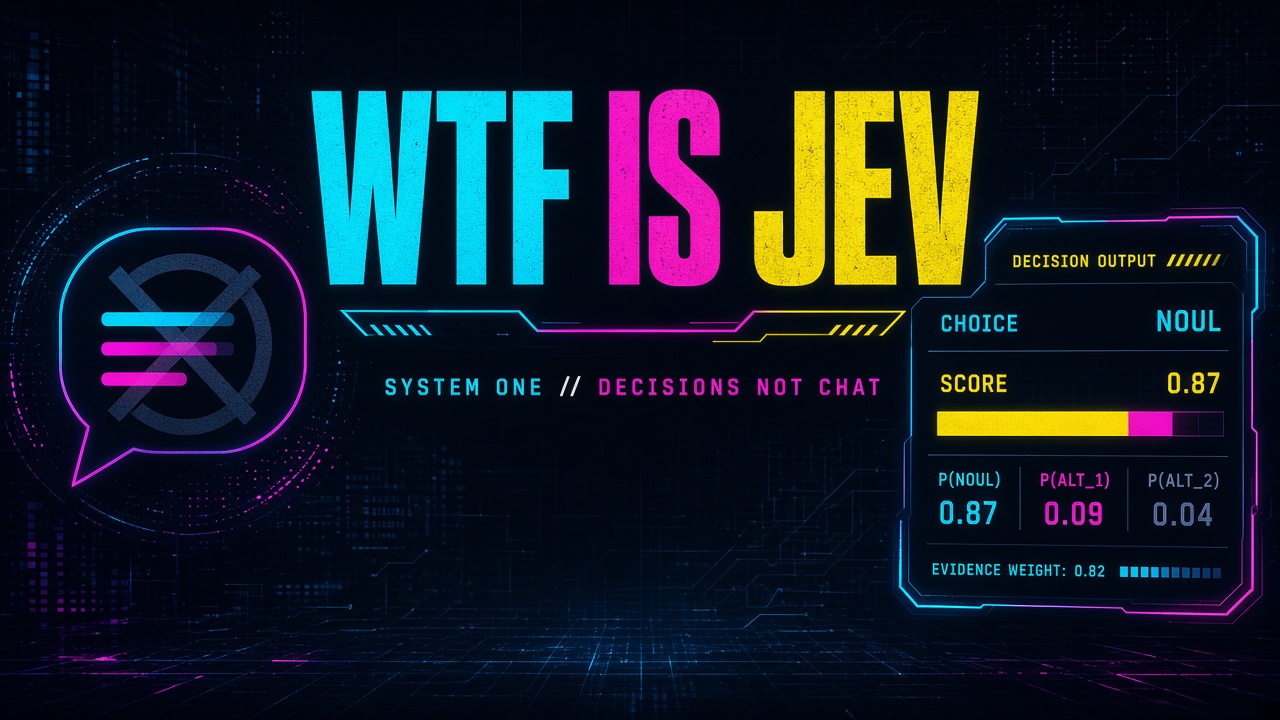
Jev is TypeSafe's System One decision model. RLCD is the interesting part. The 25-line Python version works. I am exploring, not claiming.
I still cannot figure out what Jev is useful for.
That is not a dunk. It is where I am. TypeSafe shipped a System One decision model. People cloned the shape in 25 lines of Python. My Jev agent is already running experiments. None of that has produced a clean “use it for X” answer yet.
What TypeSafe shipped
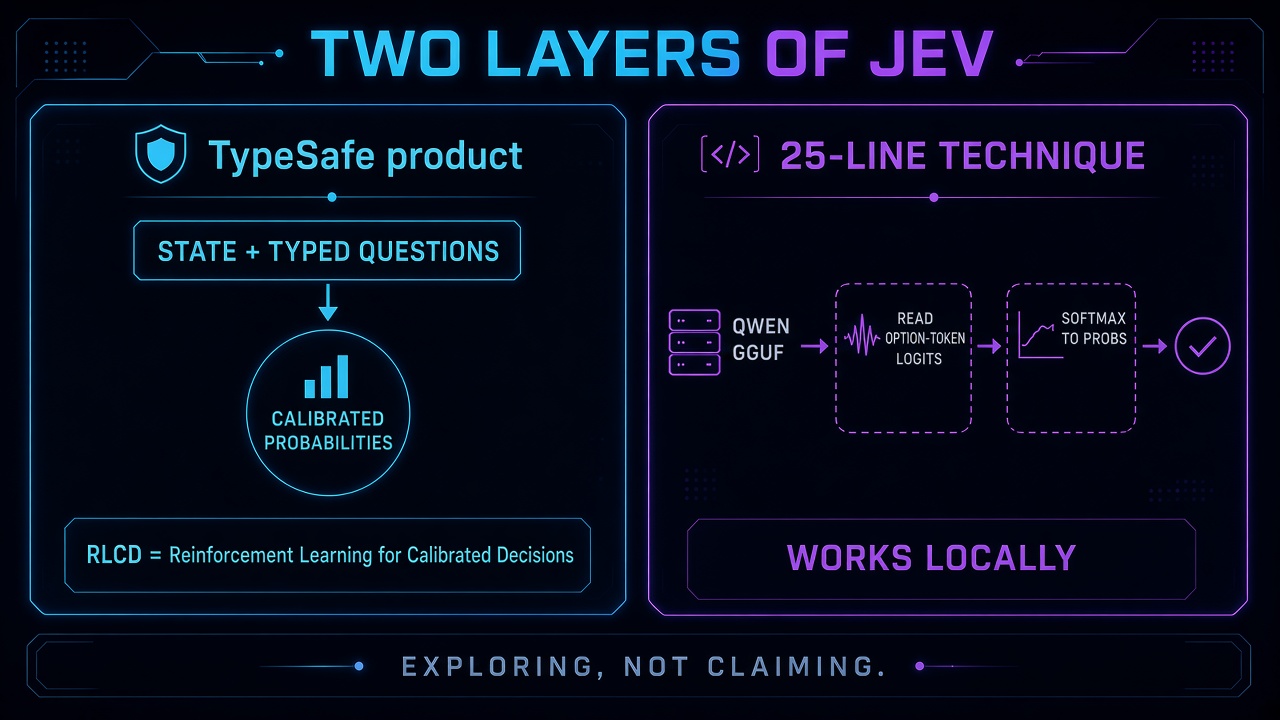
You do not chat with Jev. You send a state and typed questions. It returns structured answers with probabilities.
Question types look like choice (pick from labelled options), noul (yes/no style probability), and score. Several questions can run in one call against the same state.
The naming is deliberate. System One is Kahneman: fast decision layer, not slow deliberative chat. Jev is after William Stanley Jevons: cheaper intelligence should unlock more demand for decisions, the way cheaper coal unlocked more demand for power.
TypeSafe also claims large cost and latency wins versus using a normal LLM as a classifier, because Jev skips string generation. Fine. Still not the part I care about most.
RLCD is the real story
Reinforcement Learning for Calibrated Decisions. The pitch is that confidence should track accuracy, so software can set thresholds and mean them.
That is the interesting claim. A model that can emit a JSON label is old. A model whose confidence is usable as a software signal is a different product.
TypeSafe did this because nobody else was shipping that interface hard. Whether RLCD actually delivers calibrated confidence in the wild is what I want to poke at, not the branding.
The 25-line version is not fake
Then Hacker News filled up with demystifiers.
NobodyWho posted “Jev in 25 lines of Python”: load a tiny Qwen GGUF with llama.cpp, put the options in the prompt, read the logits on the option tokens, softmax them into probabilities. Local. Fast. No API. No RLCD story.
That version works. It is not a made-up story. If your job is “given context, score these options,” reading option-token logits is a real shape. People are cloning the interface: OpenJev, Kev on Qwen, wrappers that put a Jev-shaped API on whatever model you already have.
So there are two layers:
- TypeSafe’s trained decision model and the RLCD calibration story.
- The general technique of forcing a model to decide among options and reading probabilities instead of generating paragraphs.
Same interface shape. Different claims underneath.
What I am doing
I have a Jev agent already running experiments. Not a launch. Not a product claim. Exploring where a decision model belongs next to coding agents: gates, routers, verifiers, “is this safe / done / worth the expensive model” checks.
Most agent stacks still use a chat model for those moments, then parse the answer and pretend the parse is a contract. Jev-shaped tools attack that seam directly. Whether TypeSafe’s model is required for that, or a local logits trick is enough, is what I want to find out by using both.
No claims
Not claiming Jev replaces LLMs. Not claiming the 25-line demo is the same as TypeSafe’s frontier pitch. Not claiming I have the killer use case mapped.
Just exploring a new interface that showed up, plus a training story that might matter more than the branding, plus a local technique that already works well enough to poke at.
Article FAQ
Article takeaways
- What is Jev?
- Jev is TypeSafe AI's System One decision model. You send a state and typed questions; it returns structured answers with probabilities. It does not generate chat text.
- What is RLCD?
- Reinforcement Learning for Calibrated Decisions. TypeSafe's pitch is that confidence should track accuracy so software can set thresholds. That is the part I find most interesting.
- Does the 25-line Python Jev demo work?
- Yes. Load a small Qwen GGUF, put options in the prompt, read option-token logits into probabilities. That technique works. It is not the same as TypeSafe's trained product, but it is not vapor.
- What is Jev useful for?
- I do not know yet. The obvious agent uses are routing, tool-risk gates, and verification checks that today get handled by a chat model plus brittle parsing. I am running experiments, not shipping a verdict.
- Is this a product endorsement?
- No. TypeSafe shipped a decision interface because nobody else was. I am exploring the product and the local technique. No claims beyond that.